

 Hardening Steel Blades
 Hardening surgical blades
  Hardening Seat Belt Parts
 Hardening steel screw threads
 Hardening Cast Iron Pulleys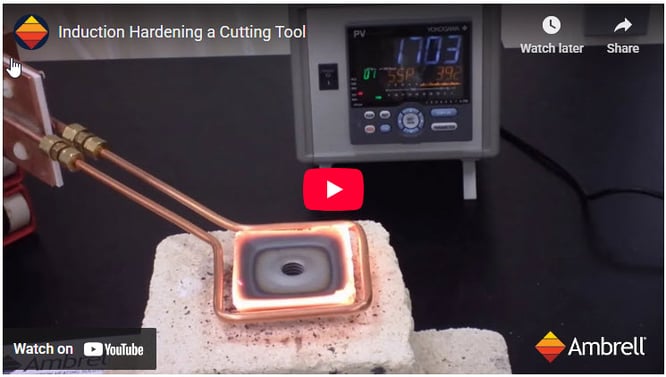






hardening Application Notes
Select from our collection of hardening notes, developed over 40 years supporting our customers. Read how we helped to solve their process heating challenges!
Optimum power is delivered to the steel blades to understand the heat pattern. The feasibility of the application is confirmed. The target temperature is achieved in less than 15 seconds.
To quickly heat a steel surgical blade to 2000 °F (1093 °C) within 2 seconds so as to harden the blade edge.
A four-turn helical concentrating coil is specially designed to deliver uniform heat to the steel seat belt retraction gear.
 Hardening the teeth of a large saw blade
A torch isn't as precise as induction nor is it repeatable; induction heating is highly repeatable, uses less energy than a torch and offers instant on/off heating
 Case hardening a steel fitting (machined parts)
The coil design enabled the part to be raised into the heating coil from the bottom. The design was also made to ensure it will work well within the customer's current setup...
 Surface hardening of steel screws
Induction heating enables precise application of heat, faster process time and production rates and the ability to be incorporated into existing production lines
 Hardening teeth on a steel motorcycle gear
A single turn helical coil is used to heat the gear. The gear is placed on a spindle and rotated at 300-350 RPM's.
A five turn helical coil is used heat the screw threads. The screw is placed in the coil, heat is applied for 8 seconds to achieve a 2 long zone at the required hardness.
 Hardening the end of steel hand-held marking stamps
To harden various size ends of hand held marking stamps. The area to be hardened is 3/4 (19mm) up the shank.
 Hardening of Steel Cam Assembly
Hardening the cam outer surfaces with induction results in uniform heating for uniform results, one coil can be used for many geometries, consistent results from piece to piece
 Case Hardening of Armature Shaft
A five-turn helical coil is used to heat the gear end of the shaft to 1700 °F
Heat cast iron pulleys to 1600 °F(871.1 °C) in order to achieve a hardness of 55 Rockwell C.
 Hardening Stainless Steel Surgical Knife Blades
A two-turn helical coil with an internal quartz tube designed to scan the length of the blade is used to heat the blade to 1850 °F (1010 °C) to achieve the desired hardness.
 Hardening Bed Knife Blade for Reel Type Lawn Mowers
The hardness desired is between 45 to 55 Rockwell C, and should be measured 0.062 in (1.6 mm) from the cutting edge.
10 Induction Heating Application Notes
 We have collected these 10 popular Application Notes to help you understand the many ways induction heating can improve your heating processes.
10 Automotive Application Notes
 We have collected these 10 popular Application Notes to help you understand the many ways induction heating can improve your precision automotive manufacturing processes.



AMBRELL CORPORATION
1655 Lyell Avenue
Rochester, NY 14606
United States
 Directions
T: +1 585 889 9000
F: +1 585 889 4030
Contact Sales
Contact Orders
Contact Service
AMBRELL B.V.
Holtersweg 1
7556 BS Hengelo
The Netherlands
Directions
T: +31 880 150 100
F: +31 546 788 154
Contact Sales
Contact Orders
Contact Service
AMBRELL Ltd.
Front Suite, 1st Floor, Charles House
148-149 Gt Charles Street
Birmingham, B3 3HT
United Kingdom
T: +44 1242 514042
F: +31 546 788 154
Contact Sales
Contact Orders
Contact Service