






Benefits of Induction Melting
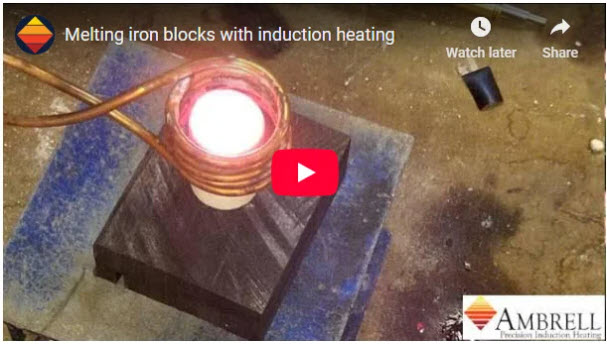
Melting metals with induction heating provides reliable, repeatable, non-contact, safe and energy-efficient heat, eliminating heat losses and workplace dangers experienced with flame. Since induction heats only the charge materials, the process is precise and efficient: it does not waste energy heating a chamber, nor does it pose the safety risk of open flame.
melting Application Notes
Select from our collection of melting notes, developed over 40 years supporting our customers. Read how we helped to solve their process heating challenges!
 Melting Glass for Fiber Drawing
To heat a metal susceptor vessel to 2200 °F within 25 minutes with induction for a fiberglass melting application
 Melting of Ni based alloy samples
Induction melting provides hands-free heating, involves no operator skill required for manufacturing, even distribution of heating and fast, controllable temperature ramp
 Heating a crucible for Melting plastic
A single-position 6-turn helical coil is used to generate the required heating for application. The crucible is heated in 70 seconds with the 5kW power supply.
 Melting silicon in graphite crucible (material testing)
The customer is developing a university lab experiment to induction melt silicon and is still developing the process.
 Melting lead ingots to form battery posts and connectors
Induction Melting 30 lb (13.6 kg) & 60 lb (27.2 kg) lead ingots to form battery posts & connectors
 Melting the end of a plastic tube to create a seal
A single turn coil encapsulated in custom blocks is used for sealing the tube. Two tubes are placed between the coil blocks and a 7lb (3.2kg) load is applied to the top of the coil.
 Crucible Melting a variety of materials in a nitrogen atmosphere
The crucible is heated using an induction coil with a four turn pancake at the base that extends upward into a three turn helical coil.
 Melting aluminum in a graphite crucible for casting
Induction melting provides hands-free heating that involves no operator skill for manufacturing, repeatable, dependable results, more efficient and cost effective then gas furnace, does not heat up the manufacturing area and increases production.
 Hermetic sealing: SS rods & glass preforms
Induction melting provides hands-free heating that involves no operator skill for manufacturing, amounts of glass are precisely controlled by the glass preforms and even flow of glass creates aesthetically pleasing bond.
 Remove plastic coating from steel tubes
Induction melting is the only feasible way to remove the plastic coating, leaving it in an unpolluted form for recycling. It is a faster process
 Releasing a Lens Grinding Fixture Bond
The bonded assembly is placed (glass up) within a helical coil which circles the bonding slug. Induction heats the material to the melting point in 5-7 seconds.
 Melting of Ticonium and Nobilium ingots
Due to the small size of the ingots, RF induction melting was required to efficiently couple to the samples in order to provide the necessary power to initiate melting.
 Melting iron powder; pucks for analysis
To heat a sample of iron powder for an induction melting application; the client manufactures metal powders



AMBRELL CORPORATION
1655 Lyell Avenue
Rochester, NY 14606
United States
 Directions
T: +1 585 889 9000
F: +1 585 889 4030
Contact Sales
Contact Orders
Contact Service
AMBRELL B.V.
Holtersweg 1
7556 BS Hengelo
The Netherlands
Directions
T: +31 880 150 100
F: +31 546 788 154
Contact Sales
Contact Orders
Contact Service
AMBRELL Ltd.
Front Suite, 1st Floor, Charles House
148-149 Gt Charles Street
Birmingham, B3 3HT
United Kingdom
T: +44 1242 514042
F: +31 546 788 154
Contact Sales
Contact Orders
Contact Service