

 Annealing Copper Tubing
 Annealing a Metal Plate
 Annealing bolt shafts
 Annealing Lock Nuts
 Annealing Tungsten Rods
 Annealing Brazing Wire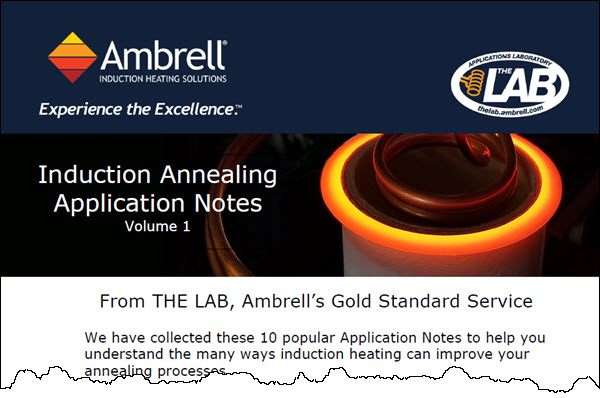






Are there Benefits to Annealing with Induction?
Annealing with induction heats only the targeted area of a workpiece, increasing production rates with faster heating cycles. Induction can reduce defect rates with repeatable, reliable heating, eliminating variability from part to part, while maintaining metallurgical characteristics of the individual metals.
 Annealing a Stainless Steel Medical Wire
Some process development may still be needed at the customer site once the induction system is delivered to account for the unique fixture/ handling techniques used
 Annealing Stainless Steel Braids
Heating took just 2-5 seconds depending on the sample used, meeting the client's requirements.
A specially designed multi-turn helical coil was used to provide the required heat to the various copper tubes.
 Annealing a Weld Seam (Steel Assembly)
To heat the weld seam of the steel part assembly
 To heat a stainless steel tube
A custom-designed single-position multi-turn helical coil was built to generate the required heating for the application.
 Annealing Springs for Stress Relief
Testing was successful, with a time-to-heat of 15 seconds. This client had been using an oven but was interested in changing to induction heating.
To heat a metal plate for an annealing application; the customer wanted to improve the heating time they were seeing with an open flame/torch.
 Heating Steel Parts for a Bending Application
Clients are looking to upgrade cutting-tool torch brazing process with a fast, controllable and repeatable process.
 Annealing a Magnetic Steel Strip
A custom-designed single position multiple-turn helical coil was built to generate the required heating for this annealing application. Initial tests were conducted to optimize the power delivered to the part.
 Annealing Copper Wire Connectors
To anneal electrical crimp contacts of different dimensions. The client took advantage of THE LAB's expertise to prove out their process in a way that met their time, quality and budgetary requirements.
 Annealing steel tubes in an inert atmosphere
Induction annealing heats steel tubes to 2000 °F (1093 °C) in an inert atmosphere for very small areas within precise production tolerances. A two-turn concentrator coil is used to heat the stainless steel tube. The annealing process takes place in an inert atmosphere to prevent oxidation.
 Annealing a Weld Seam with Induction
The client is building a system with induction. Induction achieved the client's speed requirements and induction's modest footprint works well within the system. With induction you can expect the same result every time.
 Anneal copper tubes; formed tubes & pipes
Induction annealing offers the same result every time, which makes it ideal for a high volume process such as this one. The previous oxidation issue forced them to polish the handles which added a step in their manufacturing process.
 Annealing a stainless steel handle
The client wants to anneal a stainless steel tube while avoiding oxidation. Induction annealing offers the same result every time, copper tubes of various geometries heated to temperature in a matter of seconds, which makes it ideal for a high volume process such as this one.
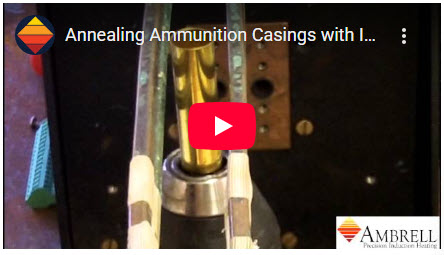
 Annealing brass ammunition casings
The ammunition industry has been annealing with inefficient methods which require much floor space, lack consistency, create excess inventory carry costs, and don't permit in-process inspections. Brass annealing with induction ensures each and every case is quality annealed, reducing variation and damage typically found in mass annealing processes.
 Annealing stainless steel tubes
Annealing with induction heated the client's parts to the desired temperature in less than three seconds. Their previously-used gas oven required twice as much heating time as the induction heating process. Induction annealing is more energy-efficient and requires less space compared to a gas oven.
 Annealing stainless steel tubing
Looking to replace an inefficient oven process, a stainless steel tube is heated in just 30 seconds, improving efficiency for this application. A custom-designed single position multi-turn helical coil was built to generate the required heating for this induction annealing application
 Annealing a copper wire connector (crimp)
The client wanted to be able to anneal parts of various sizes, which was achieved with a concentrator coil. Induction annealing is a new process for the client, and Ambrell's lab expertise proved very valuable when creating the process...
 Annealing steel wire for a medical application
Induction annealing achieved the targeted steel wire temperature within three seconds. Ambrell performed a free laboratory test, designed a cost efficient, in-house process and connected them with an automation partner to maximize productivity. The client now has better control over their end product.
 Annealing stainless steel caps (dental)
Our client had a requirement to anneal large quantities of work-hardened stainless steel crowns. Induction was suggested for its precise, controllable heating. Since oxidation is unacceptable in the finished dental product, induction heating is the appropriate choice for heating in an inert atmosphere.
 Annealing brass and bronze tubing (handrail bending)
Employing brass annealing with induction to form tubes into handrails, a twelve-turn helical coil was used to heat an 8 x 3 in (20.3 x 7.6 cm) area above the end of the tubes. Each of the four tubes require a different heat cycle and time to reach the required temperature.
 Annealing a zinc wire prior to forming pellets for air rifles
A fourteen-turn coil is used to heat 3.9 in (100 mm) of zinc wire for this zinc wire application. The wire is placed in the coil for 5 seconds to reach the desired condition just prior to the forming process.
 Annealing a hydraulic motor shaft prior to machining
A three-turn helical coil is used to anneal the steel hydraulic motor shaft. The end of the motor shaft is placed in the coil and power is applied for 20 seconds to reach 1350 °F (732 °C) and turn the steel red hot before machining.
 Annealing aluminum fuel tank fill neck for bending
An eight-turn helical is used to heat the aluminum tube for annealing. To anneal the full length of the tube, the tube is placed in the coil and heated, and then the tube is bent while hot to prevent cracking.
 Annealing of stellite tips on saw blades
To anneal the affected zone of a saw blade after the stellite tips have been welded in place, a split four-turn helical coil is used to allow the blade to move evenly through the coil. Each tip of the blade is heated for 5 seconds as it passes through the coil to anneal the affected area.
 Continuous annealing of copper wire
To anneal a copper wire used in electric motors, a twelve-turn helical coil is used with an inserted ceramic tube to isolate the copper wire from the coil and to allow the wire to flow smoothly through the coil. Power runs continuously to anneal at a rate of 16.4 yds (15m) per minute.
 Annealing lip on cryogenic dewar
A two-turn helical coil is used to heat the lip on the cryogenic dewar. The dewar is placed in the coil and power is applied for 2 minutes to anneal the required 1 heat zone...
 Anneal an oval cut-out on a stainless steel tube
To anneal an area around an oval cutout on a stainless steel tube prior to extrusion, a single-turn helical coil is used on the 4 (101.6mm) diameter tubes and a two turn helical coil is used on the smaller diameters.
 Annealing the end of steel wire on a woven wire mesh
To prepare a wire mesh for press brake bending, induction is used to heat 3 in (76.2 mm) from the end of the wire mesh 60 in (1.52 m) long. This provides a faster production process, higher efficiency, lower energy costs and a fast, controllable hands-free process that involves no operator skill.
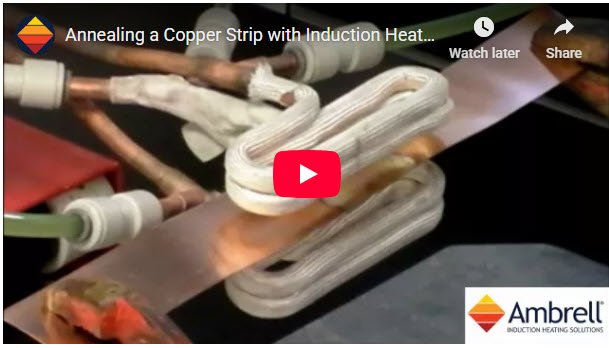
 Annealing both ends of copper tubing for refrigeration
Induction heating applies heat to very specific areas, faster process time, increased production and high efficiency. In this application, both ends of a copper tube are heated to anneal them as soft as possible 1.5 in (38.1 mm) from each end, as well as retaining full hardness next to the anneals.
 Annealing brass electrical contact for crimping
Induction annealing brass contacts provides hands-free heating that involves no operator skill, pinpoint accuracy and consistent results. To anneal a small area of an electrical contact for crimping, a one turn hairpin coil is used to heat the electrical contact to 1000 °F.
 Annealing a steel shaft for stress relief
Flameless induction heating allows processes - formerly done in batch furnaces - to be done in-line saving time and energy. No rotation of parts is needed.
A three-turn helical coil is used to heat the shaft of the bolts for 10 to 12 seconds on the large bolts and 18 to 20 seconds on the smaller bolts using the same coil. This allows for pinpoint accuracy and repeatability, cycle after cycle.
A three-turn helical coil is used to heat the locknut to 2150Ă °F for 5 seconds. Induction heating provides repeatable, rapid and accurate heating cycles making it ideal for in-line production processes
 Anneal the end of metal stamp sets
Induction annealing heats the end of a metal stamp to mushroom instead of cracking/splitting when struck by a hammer. Two helical coils are used to heat the ends to the required temperature. Two part sizes can be run in each of the coils, using the same machine settings except for cycle time.
 Annealing stainless steel bread saw blades
Induction annealing improves blade quality, decreases scrap product and is easily incorporated into existing production lines. To anneal these stainless steel bread cutting saw blades, a three-turn helical induction heating coil is designed and developed for this application.
A multi-turn induction annealing coil is used to heat various rod diameters. An optical pyrometer is used to measure the temperature of the part inside the induction coil. Initial static tests are conducted, then dynamic tests are run to confirm the results of the static tests
 Band annealing on Titanium fasteners
Our bar-end annealing systems provide operating frequencies from 400 kHz for hot-heading of small diameter fasteners to 2 kHz for larger cross-section beams or bars. Systems can be incorporated with pick-and-place robotics to deliver a flameless process,with heating limited to a specific area.
Induction annealing provides higher productivity of 27' (8.2m) per minute, a reduction in surface oxidation & scaling with consistent, repeatable results. Four consecutive coils connected in parallel with a quartz tube lining are used to heat the wire to 650 °F for annealing.
 Selectively Annealing Thread Ring Gauge Blocks
To selectively and uniformly anneal two sections of a thread ring gage block from the hole to the outside surface from a hardness of Rc 59-61 to Rc 45. Process goals include automation, production rate increase, and elimination of stress cracking resulting from flame heating.
 Achieving Uniform Hardness on Saw Blades
Induction annealing is used to draw-back steel saw blades to a desired Rockwell hardness at a rate of 60 inches per minute. Resulting mean hardness of 50.3 Rc is measured for fifteen saw teeth on a Wilson Superficial Hardness Tester, fulfilling the ultimate goal established by the customer.
Annealing brass ammunition casings
The ammunition industry has been annealing with inefficient methods which require much floor space, lack consistency, create excess inventory carry costs, and don't permit in-process inspections. Brass annealing with induction ensures each and every case is quality annealed, reducing variation and damage typically found in mass annealing processes.
Annealing brass and bronze tubing (handrail bending)
Employing brass annealing with induction to form tubes into handrails, a twelve-turn helical coil was used to heat an 8 x 3 in (20.3 x 7.6 cm) area above the end of the tubes. Each of the four tubes require a different heat cycle and time to reach the required temperature.
Annealing brass electrical contact for crimping
Induction annealing brass contacts provides hands-free heating that involves no operator skill, pinpoint accuracy and consistent results. To anneal a small area of an electrical contact for crimping, a one turn hairpin coil is used to heat the electrical contact to 1000 °F.
A specially designed multi-turn helical coil was used to provide the required heat to the various copper tubes.
Annealing Copper Wire Connectors
To anneal electrical crimp contacts of different dimensions. The client took advantage of THE LAB's expertise to prove out their process in a way that met their time, quality and budgetary requirements.
Anneal copper tubes; formed tubes & pipes
Induction annealing offers the same result every time, which makes it ideal for a high volume process such as this one. The previous oxidation issue forced them to polish the handles which added a step in their manufacturing process.
Annealing a copper wire connector (crimp)
The client wanted to be able to anneal parts of various sizes, which was achieved with a concentrator coil. Induction annealing is a new process for the client, and Ambrell's lab expertise proved very valuable when creating the process...
Continuous annealing of copper wire
To anneal a copper wire used in electric motors, a twelve-turn helical coil is used with an inserted ceramic tube to isolate the copper wire from the coil and to allow the wire to flow smoothly through the coil. Power runs continuously to anneal at a rate of 16.4 yds (15m) per minute.
Annealing both ends of copper tubing for refrigeration
Induction heating applies heat to very specific areas, faster process time, increased production and high efficiency. In this application, both ends of a copper tube are heated to anneal them as soft as possible 1.5 in (38.1 mm) from each end, as well as retaining full hardness next to the anneals.
Annealing a Weld Seam (Steel Assembly)
To heat the weld seam of the steel part assembly
Annealing Springs for Stress Relief
Testing was successful, with a time-to-heat of 15 seconds. This client had been using an oven but was interested in changing to induction heating.
Heating Steel Parts for a Bending Application
Clients are looking to upgrade cutting-tool torch brazing process with a fast, controllable and repeatable process.
Annealing a Magnetic Steel Strip
A custom-designed single position multiple-turn helical coil was built to generate the required heating for this annealing application. Initial tests were conducted to optimize the power delivered to the part.
Annealing steel tubes in an inert atmosphere
Induction annealing heats steel tubes to 2000 °F (1093 °C) in an inert atmosphere for very small areas within precise production tolerances. A two-turn concentrator coil is used to heat the stainless steel tube. The annealing process takes place in an inert atmosphere to prevent oxidation.
Annealing steel wire for a medical application
Induction annealing achieved the targeted steel wire temperature within three seconds. Ambrell performed a free laboratory test, designed a cost efficient, in-house process and connected them with an automation partner to maximize productivity. The client now has better control over their end product.
Annealing a hydraulic motor shaft prior to machining
A three-turn helical coil is used to anneal the steel hydraulic motor shaft. The end of the motor shaft is placed in the coil and power is applied for 20 seconds to reach 1350 °F (732 °C) and turn the steel red hot before machining.
Annealing lip on cryogenic dewar
A two-turn helical coil is used to heat the lip on the cryogenic dewar. The dewar is placed in the coil and power is applied for 2 minutes to anneal the required 1 heat zone...
Annealing the end of steel wire on a woven wire mesh
To prepare a wire mesh for press brake bending, induction is used to heat 3 in (76.2 mm) from the end of the wire mesh 60 in (1.52 m) long. This provides a faster production process, higher efficiency, lower energy costs and a fast, controllable hands-free process that involves no operator skill.
Annealing a steel shaft for stress relief
Flameless induction heating allows processes - formerly done in batch furnaces - to be done in-line saving time and energy. No rotation of parts is needed.
A three-turn helical coil is used to heat the shaft of the bolts for 10 to 12 seconds on the large bolts and 18 to 20 seconds on the smaller bolts using the same coil. This allows for pinpoint accuracy and repeatability, cycle after cycle.
A three-turn helical coil is used to heat the locknut to 2150Ă °F for 5 seconds. Induction heating provides repeatable, rapid and accurate heating cycles making it ideal for in-line production processes
Anneal the end of metal stamp sets
Induction annealing heats the end of a metal stamp to mushroom instead of cracking/splitting when struck by a hammer. Two helical coils are used to heat the ends to the required temperature. Two part sizes can be run in each of the coils, using the same machine settings except for cycle time.
Induction annealing provides higher productivity of 27' (8.2m) per minute, a reduction in surface oxidation & scaling with consistent, repeatable results. Four consecutive coils connected in parallel with a quartz tube lining are used to heat the wire to 650 °F for annealing.
Selectively Annealing Thread Ring Gauge Blocks
To selectively and uniformly anneal two sections of a thread ring gage block from the hole to the outside surface from a hardness of Rc 59-61 to Rc 45. Process goals include automation, production rate increase, and elimination of stress cracking resulting from flame heating.
Achieving Uniform Hardness on Saw Blades
Induction annealing is used to draw-back steel saw blades to a desired Rockwell hardness at a rate of 60 inches per minute. Resulting mean hardness of 50.3 Rc is measured for fifteen saw teeth on a Wilson Superficial Hardness Tester, fulfilling the ultimate goal established by the customer.
Annealing a Stainless Steel Medical Wire
Some process development may still be needed at the customer site once the induction system is delivered to account for the unique fixture/ handling techniques used
Annealing Stainless Steel Braids
Heating took just 2-5 seconds depending on the sample used, meeting the client's requirements.
To heat a stainless steel tube
A custom-designed single-position multi-turn helical coil was built to generate the required heating for the application.
Annealing a Weld Seam with Induction
The client is building a system with induction. Induction achieved the client's speed requirements and induction's modest footprint works well within the system. With induction you can expect the same result every time.
Annealing a stainless steel handle
The client wants to anneal a stainless steel tube while avoiding oxidation. Induction annealing offers the same result every time, copper tubes of various geometries heated to temperature in a matter of seconds, which makes it ideal for a high volume process such as this one.
Annealing stainless steel tubes
Annealing with induction heated the client's parts to the desired temperature in less than three seconds. Their previously-used gas oven required twice as much heating time as the induction heating process. Induction annealing is more energy-efficient and requires less space compared to a gas oven.
Annealing stainless steel tubing
Looking to replace an inefficient oven process, a stainless steel tube is heated in just 30 seconds, improving efficiency for this application. A custom-designed single position multi-turn helical coil was built to generate the required heating for this induction annealing application
Annealing stainless steel caps (dental)
Our client had a requirement to anneal large quantities of work-hardened stainless steel crowns. Induction was suggested for its precise, controllable heating. Since oxidation is unacceptable in the finished dental product, induction heating is the appropriate choice for heating in an inert atmosphere.
Anneal an oval cut-out on a stainless steel tube
To anneal an area around an oval cutout on a stainless steel tube prior to extrusion, a single-turn helical coil is used on the 4 (101.6mm) diameter tubes and a two turn helical coil is used on the smaller diameters.
Annealing stainless steel bread saw blades
Induction annealing improves blade quality, decreases scrap product and is easily incorporated into existing production lines. To anneal these stainless steel bread cutting saw blades, a three-turn helical induction heating coil is designed and developed for this application.
10 Induction Heating Application Notes
 We have collected these 10 popular Application Notes to help you understand the many ways induction heating can improve your heating processes.



AMBRELL CORPORATION
1655 Lyell Avenue
Rochester, NY 14606
United States
 Directions
T: +1 585 889 9000
F: +1 585 889 4030
Contact Sales
Contact Orders
Contact Service
AMBRELL B.V.
Holtersweg 1
7556 BS Hengelo
The Netherlands
Directions
T: +31 880 150 100
F: +31 546 788 154
Contact Sales
Contact Orders
Contact Service
AMBRELL Ltd.
Front Suite, 1st Floor, Charles House
148-149 Gt Charles Street
Birmingham, B3 3HT
United Kingdom
T: +44 1242 514042
F: +31 546 788 154
Contact Sales
Contact Orders
Contact Service