As global electric vehicle (EV) and hybrid vehicle adoption gains momentum, manufacturers face pressure to improve production efficiency, product quality, and process consistency. From battery packs and busbars to electric motors and power electronics, every component must meet demanding performance and reliability requirements.
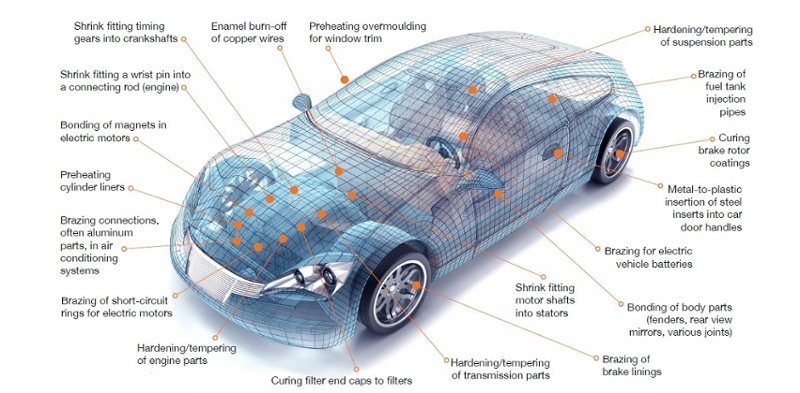
Induction heating has emerged as a critical manufacturing technology throughout the EV ecosystem. Its ability to deliver fast, precise, non-contact heating makes it an ideal solution for many battery and electric motor production processes. Ambrell's experience in automotive and EV manufacturing includes applications such as battery manufacturing, motor assembly, shrink fitting, brazing, and metal-to-plastic insertion.
Why Induction Heating for EV Manufacturing?
Unlike conventional heating methods that rely on flames, ovens, or contact heating, induction heating generates heat directly within the workpiece through electromagnetic fields. This offers several advantages:
- Rapid heating and reduced cycle times
- Precise, localized heat application
- Improved process repeatability
- Enhanced operator safety with no open flames
- Greater energy efficiency
- Easy integration into automated production lines
These benefits are particularly valuable in high-volume EV and battery manufacturing environments where consistency and throughput are critical.
Busbar Brazing and Electrical Connections
Modern EVs depend on reliable, low-resistance connections capable of carrying high currents. Copper and aluminum busbars are commonly used to connect battery cells, modules, inverters, and power distribution systems.
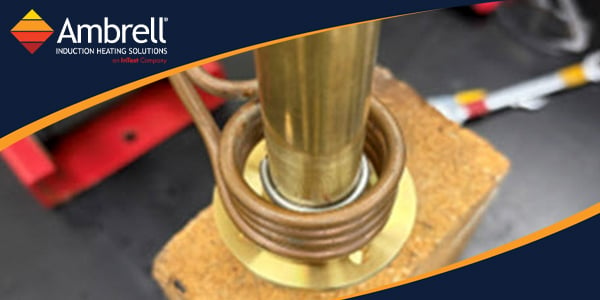
Induction heating is well suited for brazing and soldering these electrical connections because it can rapidly heat only the joint area while minimizing thermal impact on surrounding components. The process delivers consistent temperatures and repeatable braze quality, helping manufacturers produce strong, conductive joints with minimal oxidation. Similar induction brazing processes are widely used for copper electrical assemblies and battery-related cooling systems.
Key benefits include:
- Precise heat control at the joint
- Consistent braze quality
- Reduced cycle times
- Easy automation
- Minimal heat exposure to nearby components
Battery Cell and Module Manufacturing
Battery production requires strict control of contamination, moisture, and thermal conditions. Induction heating plays an important role in several battery manufacturing operations.
One common application is battery casing heating and drying. Prior to cell assembly, battery housings often require moisture removal to ensure optimal product quality and long-term performance. Induction systems can continuously and efficiently heat battery casings as they move through automated production lines.
Induction heating can also be used in shrink fit assembly operations where precision components must be joined with tight tolerances. By selectively heating an outer component, manufacturers can create temporary expansion that allows rapid assembly without excessive force or mechanical stress. Once cooled, the interference fit provides a strong, reliable connection.
Advantages include:
- Fast cycle times
- Clean, non-contact heating
- Improved assembly accuracy
- Reduced risk of component damage
- Compatibility with automated production systems
Brazing Battery Cooling Circuits
Thermal management is critical to EV battery performance, safety, and longevity. Battery packs generate significant heat during charging and discharge cycles, making efficient cooling systems essential.
Induction heating is used to braze aluminum cooling channels and fittings within battery thermal management systems. Because these assemblies often contain components with different masses and heat transfer characteristics, precise temperature control is necessary to achieve high-quality joints.
Properly designed induction coils can deliver uniform heating to both components, helping ensure consistent braze flow, leak-free connections, and reliable long-term performance. This process is particularly important for aluminum cooling circuits commonly found in EV battery packs.
Electric Motor Manufacturing
Electric motors are the heart of every EV, and induction heating supports several motor production processes.
Shrink Fitting Motor Components
One of the most common applications is shrink fitting shafts, rotors, and stators. By selectively heating one component, manufacturers achieve a controlled expansion that allows components to be assembled quickly and accurately. As the part cools, it contracts to create a secure mechanical fit.
Induction heating provides a superior alternative to ovens or flame heating because the heating is highly localized, repeatable, and fast. Automotive manufacturers commonly use induction for shrink fitting motor shafts into stators and other precision assemblies.
Rotor and Stator Processing
Induction heating is also used for:
- Brazing short-circuit rings in electric motors
- Bonding magnets into rotor assemblies
- Applying varnish or wax to rotors and stators
- Heat treating selected motor components
These processes benefit from induction's ability to deliver precise, repeatable heating while maintaining tight manufacturing tolerances.
Supporting Automated EV Production
As EV manufacturers continue to scale production, automation becomes increasingly important. Induction heating systems integrate seamlessly with robotics, conveyors, and automated assembly lines.
Because heating occurs almost instantly and can be tightly controlled, induction systems help manufacturers achieve:
- Higher throughput
- Improved product consistency
- Reduced energy consumption
- Greater process traceability
- Lower operating costs
These advantages make induction heating a valuable enabling technology across the entire EV manufacturing process.
A Critical Tool in EV Manufacturing
From battery cell preparation and busbar brazing to motor assembly and thermal management systems, induction heating provides the speed, precision, and repeatability needed for modern EV production.
As battery technology continues to evolve and vehicle manufacturers pursue greater efficiency and higher production volumes, induction heating will remain a key technology helping manufacturers build safer, more reliable, and more cost-effective electric vehicles.
At Ambrell, our engineers work with OEMs, integrators, and Tier suppliers to develop induction heating solutions tailored to the unique requirements of EV and battery manufacturing applications, helping bring the next generation of electrified transportation to market.
Learn more about how induction heating is used in automotive manufacturing.