Induction heating is an ideal process for high volume applications that demand repeatability. That is certainly the case in the automotive industry, and consequently, induction is readily utilized. First, let's cover the benefits of using induction heating for automotive applications:
- Precise control of heat: Induction heating can be used to heat specific areas of a metal part, which is critical for many manufacturing processes, including heat treatment, annealing, and brazing. This precision control can help to ensure that the part is heated to the correct temperature and that the heat is evenly distributed. Ultimately, this helps ensure quality.
- Fast heating cycles: Induction can heat metal parts rapidly, which can lead to improved production rates. For example, induction heating can be used to heat a camshaft gear from room temperature to the target temperature in just minutes.
- Reduced defects: The precise control of heat and the fast heating cycles of induction heating can help to reduce defects in metal parts. For example, induction heating can be used to heat a steering knuckle or upright without discoloring it, which helps to prevent corrosion.
- Improved safety: Induction heating is a flameless process, which means there's no open flame in the work environment. This of course makes it a safer process than traditional methods of heating, such as flame brazing or soldering.
- Environmentally friendly: Induction heating is an energy-efficient process with instant on/off heating which is powered by electricity instead of gas, which results in fewer emissions than traditional methods of heating. This makes it a more environmentally friendly industrial heating process.
Overall, induction heating is a versatile and efficient process that can be used for a variety of automotive manufacturing applications. Now, let's review some examples of how induction heating is used in automotive manufacturing:
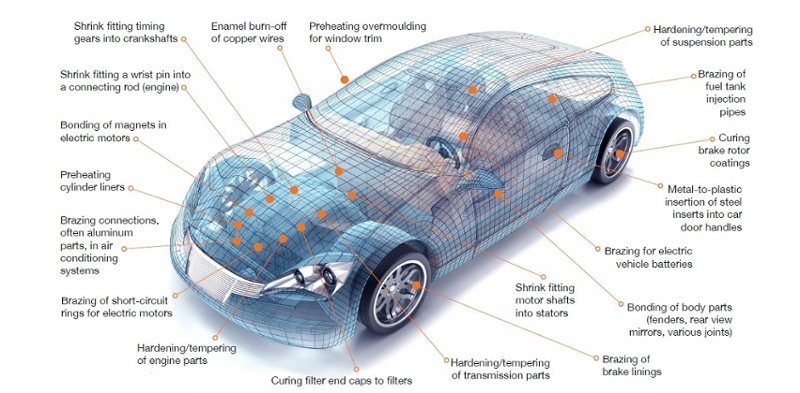
- Shrink Fitting: This process involves using induction heating to expand a metal component so that it can be inserted into another metal component. Shrink fitting motor shafts into stators is one example of how this application is used in the automotive industry.
- Heat treatment: Induction heating is used to heat metal parts for heat treatment, which is a process that changes the properties of the metal. For example, induction heating can be used to harden steel, which increases its strength and makes it more wear resistant.
- Annealing: Induction is also used to anneal parts, which is a process that softens the metal and makes it more ductile. This is ideal for parts that require bending or shaping.
- Soldering: Induction heating is used to solder metal parts, which is a process that joins two pieces of metal together with a molten filler metal. This is a common process in automotive manufacturing for joining electrical components.
- Brazing: Induction is used to braze metal parts, which is a process that joins two pieces of metal together with a molten filler metal that has a lower melting point than the base metals. This is a common process in automotive manufacturing, with application examples including joining parts in air conditioning systems, brazing brake linings, and brazing electric vehicle batteries.
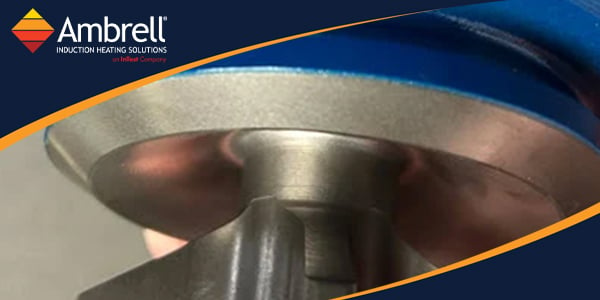
These are just a few examples of how induction heating is used in automotive manufacturing. Our applications engineers have worked on countless automotive manufacturing applications involving induction heating, with the image above giving you a sense of the breadth of applications. Click on the image below to read some of their automotive manufacturing application notes.